
If you’ve watched an Olympic swimming final recently, you’ve probably noticed something interesting.
The best swimmers aren’t always winning because they’re taking better strokes. More often than not, they’re gaining ground before they even begin swimming. That’s the power of underwater kicking drills. When practiced consistently, these drills help swimmers develop a faster Underwater Dolphin Kick, improve body position, and gain FREE SPEED off every start and turn.
In modern competitive swimming, the underwater phase has become one of the most important parts of every race. A swimmer who can maintain velocity off the start and every turn has a significant advantage over one who surfaces too early or loses momentum before taking their first stroke.
Unfortunately, most swimmers spend the majority of practice focusing on what happens above the surface. They work on their pull, recovery, and breathing patterns, yet devote very little time to the skills that often determine who reaches the wall first.
As coaches, we know that starts and turns can account for a significant portion of every race. If swimmers want to maximize those opportunities, they need an Underwater Dolphin Kick that is efficient, controlled, and repeatable.
In this article, I’ll walk you through six of my favorite underwater kicking drills that I use with swimmers to improve undulation, body position, kick timing, and overall underwater speed. Whether you’re just learning the fundamentals or refining your race skills, these drills will help you become faster every time you leave the wall.
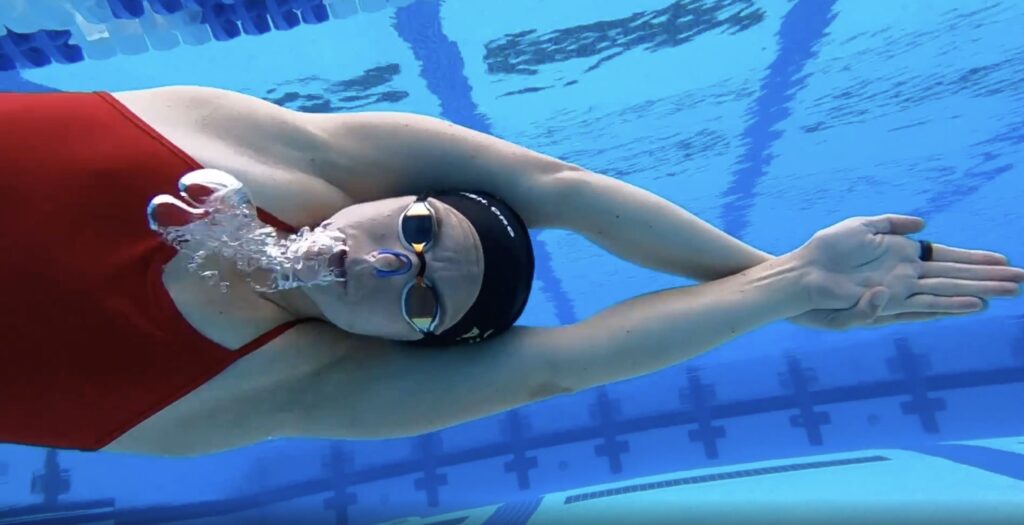
The Underwater Dolphin Kick is often called the Fifth Stroke for a reason.
When swimmers push off the wall, they are traveling significantly faster than they can swim on the surface. The goal of the Underwater Dolphin Kick is not to create speed from scratch — it’s to preserve as much of that speed as possible for as long as possible.
This is where many swimmers get confused.
They assume a faster Underwater Kick comes from kicking harder. In reality, the swimmers with the best underwater speed are usually the ones who lose speed the slowest. They maintain a tight streamline, minimize drag, and transfer energy efficiently through the body.
Think about the best underwater kickers in the world. Their movements rarely look violent or exaggerated. Instead, their kicks appear smooth, connected, and controlled. Every movement serves a purpose.
The Underwater Dolphin Kick begins with a coordinated wave that travels through the entire body. While the hands remain in streamline position, they should move slightly—often just a few inches—to help initiate the movement. The wave starts at the fingertips and upper body, flows through the chest, is amplified by the hips, and finishes through the feet. When this sequence happens correctly, swimmers create propulsion while maintaining excellent body position.
As a coach, one of the most common mistakes I see is swimmers focusing exclusively on power while ignoring body position. Yet body position is often the factor that separates average underwater kicking from elite underwater kicking. A swimmer with a great streamline and efficient movement pattern will often outperform a stronger swimmer with poor mechanics.
This is why Underwater Dolphin Kicking deserves dedicated practice. Every start and every turn provides an opportunity to gain free speed. Over the course of a race, those small advantages add up quickly. At the highest levels of swimming, the difference between first and eighth place is often measured in tenths of a second, and many of those tenths are won or lost underwater.
Phase 1 — Build Body Position & Awareness
Before swimmers can improve their Underwater Dolphin Kick, they first need to develop awareness of how their body moves through the water.
This drill is one of my favorites because the water provides immediate feedback. When the entire body is submerged, swimmers can often feel imbalances that are difficult to detect while swimming on the surface. Some athletes kick harder with one leg than the other. Others generate a strong down-kick but lose effectiveness during the up-kick.
The goal is to push off in a tight streamline and maintain a consistent Freestyle Kick while paying close attention to how the body feels. Rather than focusing on speed, focus on symmetry. The more balanced your kick becomes, the easier it will be to develop efficient underwater movement later on.
Many swimmers are surprised by what they discover during this drill. Sometimes the water tells you more than a coach can.
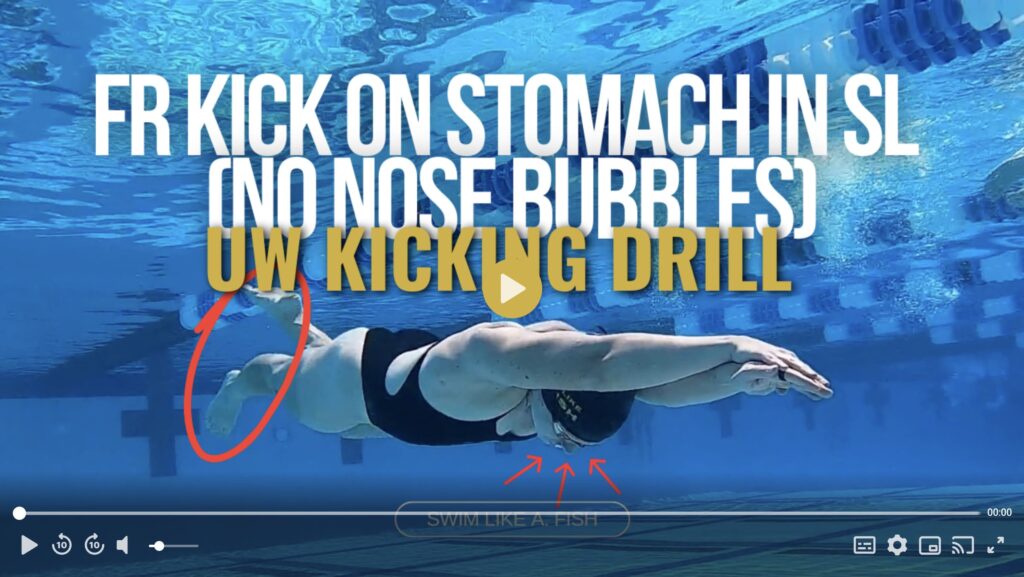
Variation #1: No Nose Clip
This variation teaches swimmers to maintain body control while managing a natural underwater exhale. It is a great starting point because it closely resembles what swimmers experience during racing and training.
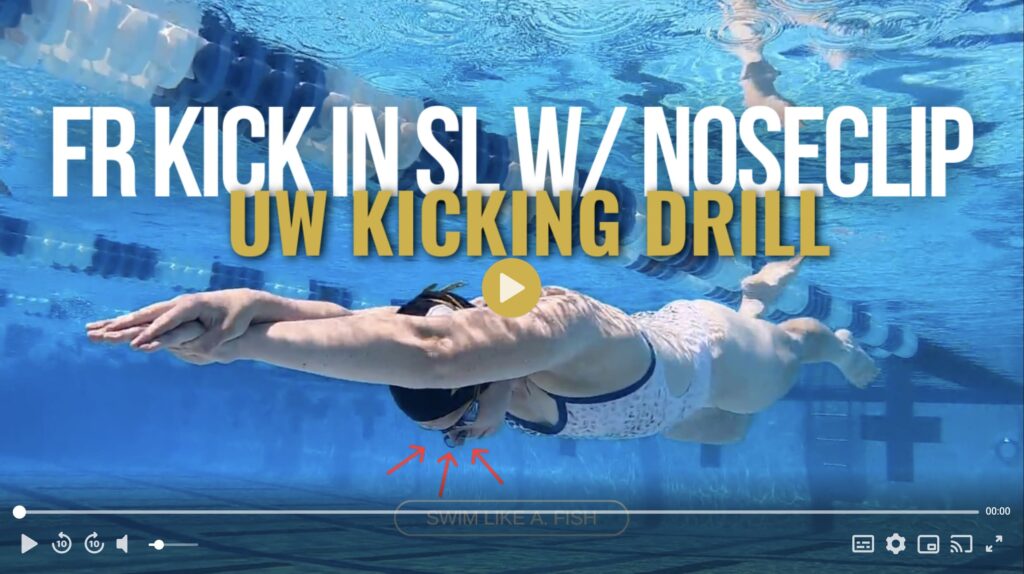
Variation #2: With Nose Clip
Adding a nose clip allows swimmers to remain underwater longer without continuously exhaling through the nose. Since carbon dioxide typically builds up during the underwater phase and creates the urge to breathe, many swimmers surface sooner than intended. The nose clip helps reduce this limitation, allowing athletes to travel farther and spend more time focusing on body position, balance, and kick mechanics.
Once swimmers can maintain a strong streamline, I like progressing to side kicking.
This drill helps swimmers develop balance and body control while maintaining a long body position in the water. Many swimmers quickly discover that one side feels stronger or more stable than the other. Identifying these differences is important because asymmetries often show up later in both swimming and Underwater Dolphin Kicking.
One challenge swimmers face is staying underwater. The body naturally wants to float toward the surface, especially through the upper body. To counteract this, swimmers should slightly angle their head and chest toward the bottom of the pool while maintaining a long body line.
The goal is to maintain alignment from the fingertips through the toes while producing a small, controlled kick. If the body is rotating, wobbling, or drifting upward, excess drag is being created and speed is being lost.
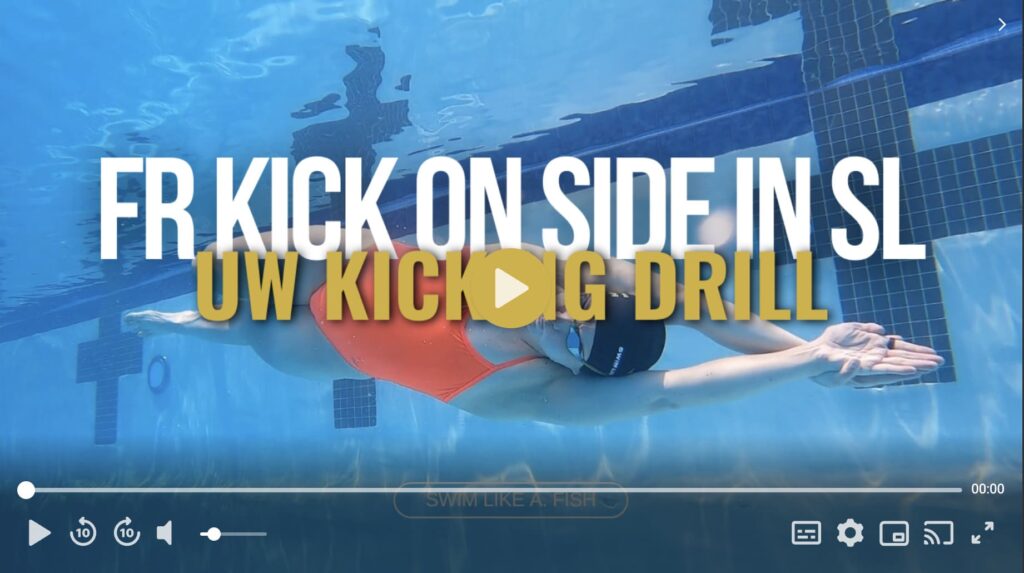
Variation #1: Underwater
Perform the drill completely submerged while maintaining a tight streamline position. Focus on balance, body alignment, and keeping the body moving in a straight line through the water.
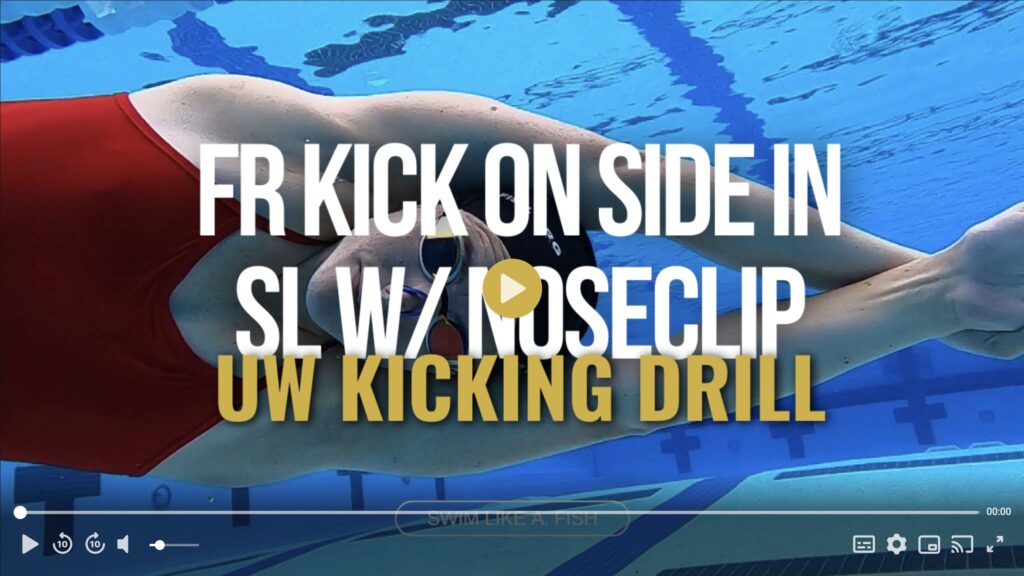
Variation #2: Near the Surface (Nose Clip)
This variation allows swimmers to ride much closer to the surface while remaining on their side. Think of the body position as similar to a Butterfly swimmer during the undulation cycle. Instead of focusing on staying deep underwater, focus on maintaining balance and body control while interacting with the surface.
The nose clip allows swimmers to stay in the position longer without being limited by continuous exhalation. As simple as this drill appears, it teaches an important lesson: the fastest underwater swimmers are not always working harder. They’re often moving more efficiently.
Phase 2 — Learn the Dolphin Wave
I love this drill because it helps swimmers feel how the wave travels through their body. Many athletes understand that Dolphin Kicking should resemble an undulation, but they struggle to identify where that movement actually begins.
Just like the previous drill, maintaining a slight downward angle is important. The body naturally wants to float toward the surface, so swimmers must direct their head and chest slightly downward while staying long through the torso.
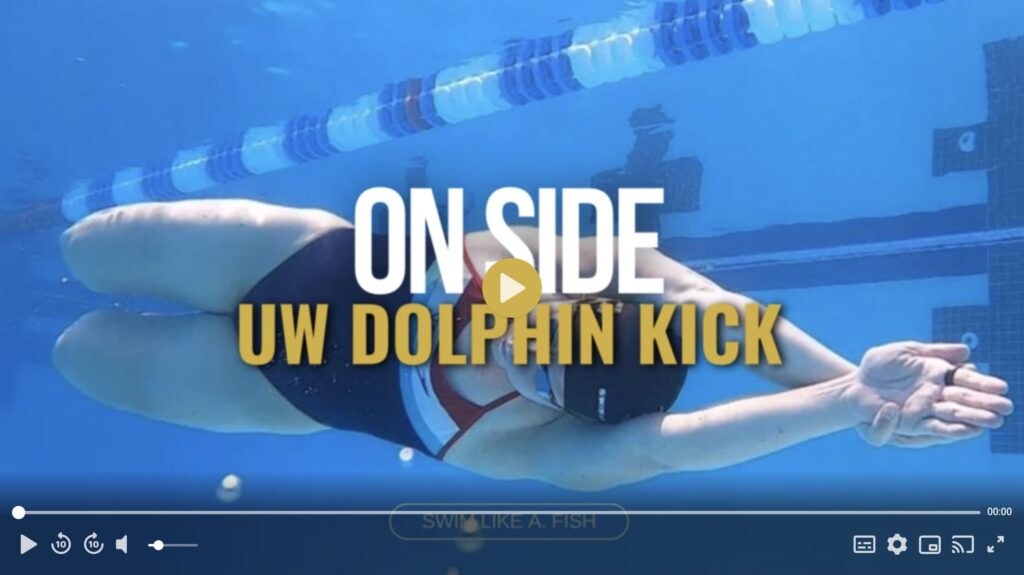
This drill also exposes imbalances that are often hidden during normal swimming. If one side of the kick is stronger than the other, swimmers will often drift left or right instead of traveling in a straight line. That immediate feedback makes it much easier to identify and correct asymmetries.
Focus on creating a smooth, connected wave through the entire body. The movement should flow from the upper body through the hips and into the feet.
Swimmers who kick primarily from their knees often create large movements that look powerful but do very little to maintain speed. Remember, the feet create propulsion, but the rest of the body helps transfer energy to them.
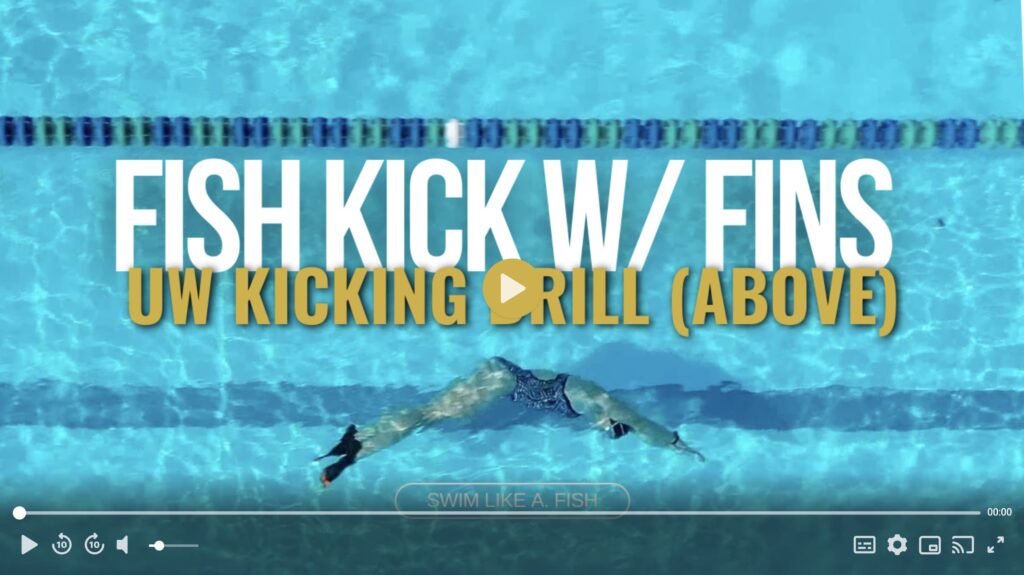
One of the best ways to develop proper undulation is to exaggerate the movement.
This drill can be performed with or without fins, depending on the swimmer and the coaching objective. Swimmers begin with a few Underwater Dolphin Kicks before rotating onto their side and producing a large, smooth wave through the body. I often tell swimmers to imagine they’re a large fish or shark swimming through the water. The movement should flow from side to side as one connected motion — not just from the legs.
Unlike many kicking drills, this is not a speed drill. Perform the movement slowly and with complete control. Slowing the drill down helps swimmers feel how the wave begins through the chest, travels through the core and hips, and finishes at the feet. The goal is to develop awareness of how the entire body contributes to the Underwater Dolphin Kick.
This is an exaggeration drill. By making the movement larger and more deliberate during practice, swimmers develop a better feel for proper undulation. When they return to normal Underwater Dolphin Kicking, it’s much easier to produce a smaller, tighter, and more efficient wave.
One of the biggest misconceptions about the Underwater Dolphin Kick is that all of the propulsion comes from the down kick.
While the down kick is certainly important, a fast Dolphin Kick is a bidirectional movement. Both the up kick and down kick work together to create one smooth, continuous wave through the body.
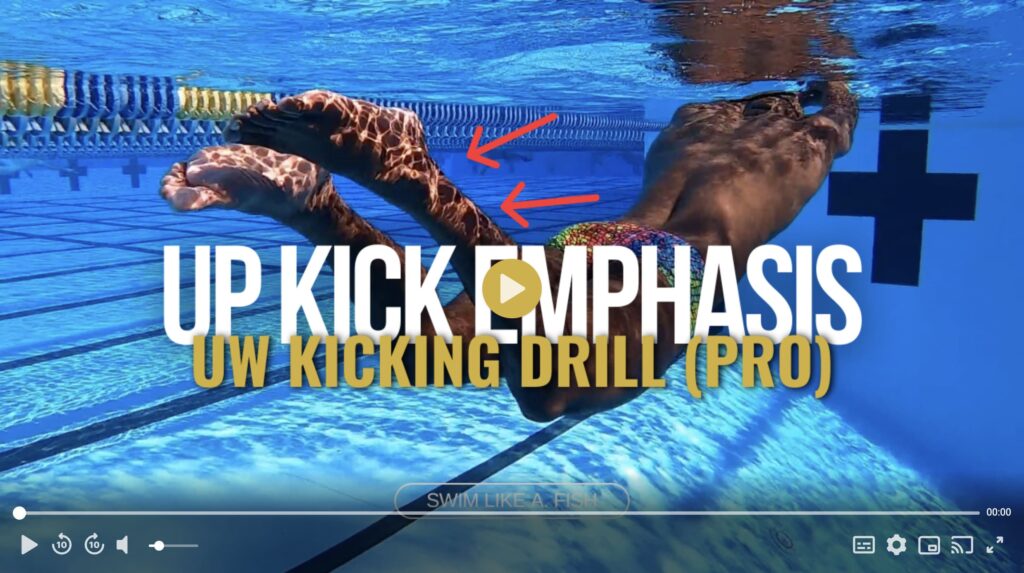
This drill places extra emphasis on the up kick, which is often the weaker phase for many swimmers. Not only does the up kick require strength and coordination through the core, lower back, and hips, but swimmers are also working against gravity during this portion of the movement. That’s one of the reasons it feels more difficult and why so many swimmers rush through it.
Unlike many underwater drills, this is not a speed drill. Slow the movement down just enough to feel each phase of the kick, but don’t make the up kick sluggish. I like having swimmers count a quick “1-2-3” during the up kick, followed immediately by a fast “1” on the down kick. The quick count encourages swimmers to spend slightly more time developing the up kick without losing the rhythm of the entire movement.
As you become more comfortable with the drill, the transition between the up kick and down kick should become almost seamless. Remember, you’re not trying to create two separate kicks. You’re trying to produce one continuous wave that travels smoothly from your chest through your hips and all the way to your feet.
Phase 3 — Refine Timing
This is one of my favorite drills for swimmers who struggle with timing and sequencing.
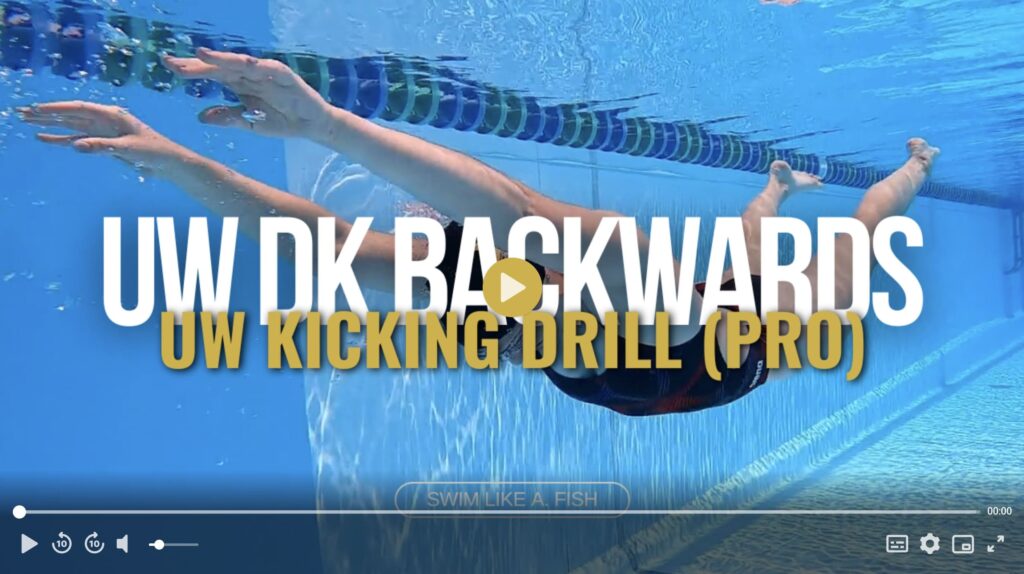
Swimming feet-first forces athletes to slow down and pay attention to how the wave moves through their body. Any disconnect between the core, hips, knees, ankles, and feet becomes much easier to identify.
One of the biggest lessons this drill teaches is how much propulsion comes from the upper body. Many swimmers assume the legs do all the work, but this drill quickly reveals how the hands, arms, chest, and core help initiate and transfer energy through the body.
This is not a kicking drill. Instead, focus on creating the wave and developing body awareness. The goal is to feel how each segment contributes to the movement pattern.
Remember, a successful Underwater Dolphin Kick is not just about strength. It is about transferring energy efficiently from one segment of the body to the next.
One of the biggest mistakes swimmers make is trying to create propulsion by kicking from their knees.
While the knees certainly move during a Dolphin Kick, they should not be the primary source of the movement. An effective Underwater Dolphin Kick starts through the core and hips before transferring energy down the legs and into the feet. Swimmers who overemphasize knee bend often create large movements that increase drag and make it difficult to maintain velocity off the wall.
Another common problem is losing the streamline position.
Many swimmers push off the wall in a great streamline, only to let their hands separate, lift their head, or relax their core a few kicks later. The result is simple — more drag and less speed. Remember, the purpose of Underwater Dolphin Kicking is to maintain the velocity generated from the push-off. A poor streamline makes that almost impossible.
I also see swimmers making their kicks much larger than necessary.
Bigger is not always better.
In fact, some of the fastest underwater kickers in the world use relatively small, tight, and fast kicks. Large amplitudes may feel powerful, but they often create more resistance than propulsion. The goal is to move forward, not up and down.
Tempo also matters. For many elite swimmers, an Underwater Dolphin Kick tempo around 0.3 seconds per kick creates a smooth, connected rhythm. The kick should feel quick and continuous, with the wave flowing through the entire body rather than separate body parts working independently.
Finally, swimmers frequently struggle with Kick Timing. The Dolphin Kick should feel like one continuous wave moving through the body — almost like a ping pong ball bouncing back and forth, with no pauses between the up kick and down kick. When the chest, hips, knees, ankles, and feet stop working together, the movement becomes disconnected and speed is lost.
The same principle applies to Underwater Dolphin Kicking.
The more connected the movement pattern becomes, the easier it is to maintain speed underwater. Remember what we’ve discussed throughout this article—the goal is not to create speed with your Dolphin Kick. The goal is to maintain the high velocity generated from the wall for as long as possible.
Before your next practice, ask yourself three simple questions:
If the answer is yes, you’re already on your way to becoming a faster underwater swimmer.
Want to put these drills into action? Try this progression during your next practice.
4×15 Freestyle Kick In Streamline
4×15 Freestyle Kick On Side
4×15 Underwater Dolphin Kick On Side
4×15 Underwater Dolphin Kick On Side
4×15 Fish Kick
4×15 Up Kick Emphasis
6×25 Underwater Dolphin Kick
4×15 Fish Kick
4×15 Up Kick Emphasis
4×15 Dolphin Kick Backwards
8×25 Underwater Dolphin Kick
4×25 Max Distance Underwater Kick
Focus on maintaining technique as fatigue increases. That’s where real improvement happens.
There is no shortcut to developing a great Underwater Dolphin Kick. Like any technical skill in swimming, it requires practice, repetition, and attention to detail. The swimmers who consistently separate themselves off the walls are not always the strongest athletes in the pool. More often than not, they are the swimmers who have learned how to maintain velocity better than everyone else.
Throughout this article, we’ve discussed several key concepts: maintaining a tight streamline, creating a smooth and connected wave through the body, minimizing drag, and using small, tight, and fast kicks. While each of these skills may seem simple on their own, putting them together consistently is what creates an elite Underwater Dolphin Kick.
As you work through these drills, remember that the goal is not to create speed underwater. The push-off from the wall creates the speed. Your job is to maintain that velocity for as long as possible before transitioning into your stroke.
Master that skill, and you’ll gain valuable FREE SPEED in every race.
If you’re looking for a complete training plan that incorporates Underwater Dolphin Kicking, Technique Development, Race Strategy, and Swim-Specific Conditioning, check out our Swimming Workout Plans for Swimmers.
Our plans are designed to help swimmers train smarter, improve technique, and maximize performance in every race.
Want to take your starts, turns, and underwater skills to the NEXT LEVEL? Explore our Starts & Turns Courses, where you’ll learn how elite swimmers maximize speed off every wall through better push-offs, Underwater Dolphin Kicks, Breakouts, and Turn Technique.
And if you’d like personalized feedback, our Video Analysis Packages provide a frame-by-frame breakdown of your stroke, starts, turns, and underwater technique so you know exactly where you’re gaining—or losing—valuable speed.
Abbie Fish, elite swim coach, technician, and founder Swim Like A Fish