
Most swimmers spend countless hours improving their stroke technique. They work on their catch, kick, turns, body position, and Underwater Dolphin Kicks. While all of those skills matter, the fastest swimmers don’t improve because of pool time alone. They also become better athletes outside the water.
That’s where dryland training comes in. A well-designed dryland program helps swimmers develop strength, coordination, mobility, balance, and body awareness that directly transfer into faster swimming. It doesn’t replace swim practice. It enhances it.
The key is understanding that dryland training should evolve as swimmers grow. An 8-year-old doesn’t need the same exercises as a high school swimmer, and a teenager shouldn’t train like an Olympic athlete. Every stage of development has different priorities, and the most effective dryland programs grow alongside the athlete.
In this guide, we’ll break down how dryland exercises for young swimmers should change with age, what coaches and parents should prioritize, and how to build a long-term athletic foundation that leads to faster swimming.

One of the biggest mistakes coaches and parents make is assuming every swimmer should follow the same dryland routine. Athletic development doesn’t work that way. Children develop coordination before strength, and during puberty, rapid growth changes balance, flexibility, and movement patterns.
Every stage serves a purpose. If swimmers rush into advanced strength training too early, they often develop poor movement habits that are difficult to correct later. Dryland should follow the same progression as learning a stroke: first movement, then stability, followed by strength, and finally power.
Before diving into age-specific dryland recommendations, it’s helpful to understand how swimmers progress through competitive swimming. Our guide to USA Swimming’s Age Group Swimming Levels explains how athletes move through different competition levels and why training should evolve throughout that journey.
| Age Group | Primary Goal | Example Exercises |
| 6-8 years | Coordination and body awareness | Animal walks, relay races, balance drills |
| 9-10 years | Movement quality and body control | Squats, lunges, planks, streamline holds |
| 11-13 years | Strength, mobility, and power | Pull-ups, medicine balls, resistance bands |
| 14+ years | Performance and injury prevention | Progressive strength work, explosive training, mobility |
This table is not meant to be a strict rule. It is a simple progression. The goal is to match the workout to the swimmer’s current stage instead of forcing every athlete into the same dryland plan.
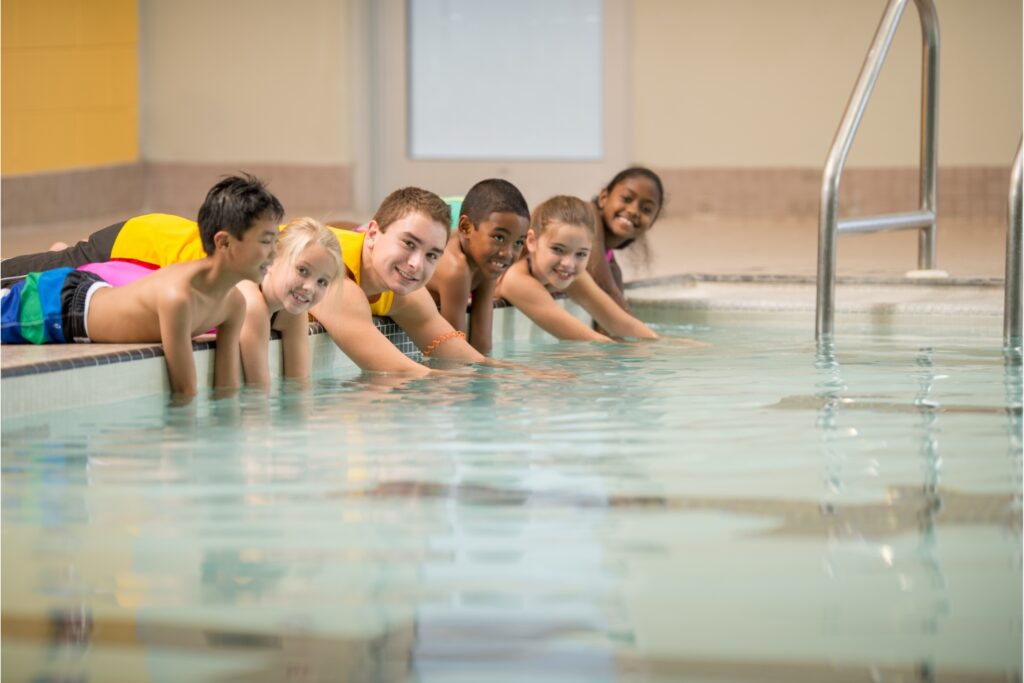
When parents search for dryland for 8 year old swimmers, they often expect to find strength exercises. In reality, strength isn’t the priority yet. At this age, swimmers are still learning how their bodies move, so dryland should focus on developing athletic skills they can build on for years.
Instead of making workouts feel like conditioning, coaches should use activities that keep kids moving and having fun. Some of the best options include:
These exercises improve coordination, balance, agility, rhythm, and body awareness while teaching swimmers how to control their bodies. That body control eventually carries over into better streamlines, stronger underwater positions, and more efficient swimming.
Bodyweight exercises can absolutely be part of the program, but quality should always come before quantity. One perfect squat teaches more than twenty rushed repetitions, and a controlled plank is far more valuable than holding poor posture for an extra minute. If coaches reward good movement instead of simply counting reps, young swimmers will build confidence and enjoy dryland more.
By the time swimmers reach 9 or 10 years old, they’re usually ready for a little more structure. That doesn’t mean heavy weights or long conditioning sessions. Instead, this stage is all about learning how to control the body through a full range of motion while building movement patterns that will support future strength training.
This is a great time to introduce exercises that swimmers will continue using throughout their careers, including:

Notice that almost every exercise teaches body control before strength. That’s intentional. Swimmers who can stabilize their core and move efficiently on land usually maintain better body position in the water, hold tighter streamlines, and transfer more power into every stroke.
Coaches should continue emphasizing movement quality during every repetition rather than simply increasing the difficulty. Building good mechanics now creates a strong foundation for more advanced strength and power training in the years ahead.
As swimmers enter the 11 to 13 age group, their bodies begin changing quickly. Some athletes grow several inches in a single season, while others suddenly gain strength or temporarily lose coordination as they adjust to longer arms and legs. All of these changes are completely normal, and dryland should help swimmers adapt instead of fighting them.
This is a great time to introduce more advanced athletic movements, such as:
Mobility becomes especially important during these growth years because tight muscles can affect stroke technique and increase injury risk. Many swimmers in this age range are also progressing through USA Swimming’s age group competition structure, where stronger athletic development becomes increasingly important as races become more competitive.
Keep in mind that two swimmers of the same age may be at very different stages of development. One 12-year-old may be ready for more strength work, while another still needs extra time improving coordination and mobility. The workout should always match the athlete, not simply their age.
Video: Explosive Dryland Workout
Once swimmers consistently demonstrate good movement mechanics, it’s time to introduce explosive exercises. While many people think swimming is primarily an endurance sport, races are often decided by explosive starts, powerful turns, and fast underwater dolphin kicks. Those qualities begin with the right dryland training.
This workout includes just two exercises:
The streamline hollow flutter kick reinforces one of the most important positions in competitive swimming by teaching athletes to maintain core tension throughout the movement. Jump squats develop explosive leg power that transfers directly to faster starts, stronger push-offs, and more powerful underwater kicking.
There’s another lesson hidden in this workout. You don’t need twenty different exercises to build better swimmers. A few well-executed movements performed with excellent technique will almost always produce better results than a long workout filled with sloppy repetitions.
By the time swimmers reach high school, dryland becomes more performance-driven. At this stage, many athletes have enough movement experience to safely build strength, power, and athletic resilience. The goal is no longer just learning how to move well. The goal is learning how to produce more force and stay healthy through harder training.
High school swimmers can usually handle more structured strength and power work, including:
This does not mean every high school swimmer needs to lift heavy right away. Technique still matters. Athletes should earn progressions by showing control, consistency, and good mechanics.
For older swimmers, dryland should support the parts of swimming that demand the most power. Stronger legs help with starts, turns, and push-offs. Better core control helps swimmers hold body position under fatigue. Stronger shoulders and upper backs support a better catch and reduce the risk of overuse injuries during high-volume training.
Video: Dancing Dryland Warm-Up
One of the biggest mistakes coaches make is assuming every dryland session needs to feel serious. Young swimmers don’t need military-style workouts. They need energy, variety, and reasons to look forward to practice.
This may not look like a traditional workout, but that’s the point. The athletes are moving, laughing, and warming up without even thinking about it. By the time they get into the pool, they’re physically prepared and mentally excited to train.
The best dryland workouts do more than build strength. They create an environment where swimmers enjoy working hard together, and that enjoyment leads to better consistency throughout the season. Over the long term, consistent training will always produce better results than trying to make every workout as hard as possible.
Dryland should help swimmers become stronger, healthier, and more athletic, but only when it’s appropriate for their age and stage of development. Too often, coaches and parents focus on making workouts harder instead of making them better. That approach can slow progress and even increase the risk of injury.
Some of the most common mistakes include:
Instead, young swimmers should first learn to move well before adding more difficult exercises or extra intensity. Dryland should complement what happens in the pool by improving coordination, mobility, balance, stability, strength, and eventually power.
Finally, remember that more isn’t always better. A focused 15 to 20-minute session performed with excellent technique will almost always produce better results than an hour of rushed exercises.
No. Young swimmers should focus on bodyweight exercises, coordination, balance, agility, and learning proper movement patterns before adding external resistance. There is plenty of time to build strength later.
The best dryland exercises depend on the swimmer’s age and development. Younger swimmers usually benefit most from animal walks, balance drills, relay races, jumping drills, squats, planks, and streamline holds. Older swimmers can gradually add pull-ups, medicine balls, resistance bands, and more structured strength work.
No. Dryland complements swimming, but it does not replace time in the water. Swimmers still need regular pool practice to improve technique, endurance, timing, and feel for the water.
For most young swimmers, dryland sessions should be short and focused. Younger swimmers may only need 10 to 15 minutes, while older age group and high school swimmers may be able to handle longer sessions depending on their swim schedule and training experience.
Not at all. Even swimmers who are not racing at a high level can benefit from better coordination, balance, flexibility, strength, and body awareness. These skills help swimmers move with more confidence in and out of the water.
The best dryland exercises for young swimmers are not determined by age alone. They are determined by where each athlete is in their development. Some swimmers need better balance, others need stronger core stability, and some are ready to build explosive power.
That’s what makes coaching so rewarding. Our job isn’t to find the hardest workout. It’s to find the right workout.
When swimmers learn to move well first, strength becomes easier to build. When strength improves, power naturally follows. When all of those qualities come together, faster swimming becomes the result.
If you’re looking for a complete progression instead of trying to create workouts every week, check out our 4-Month Dryland Season Plan, Virtual Dryland Strength Training, and Strength & Conditioning Programming for Coaches. Each program is designed specifically for swimmers and provides progressive workouts that develop movement quality, mobility, strength, and power throughout the season.
The goal isn’t to create exhausted swimmers. The goal is to develop healthier, stronger, more confident athletes who transfer everything they learn on land directly into faster swimming.