
Welcome back! As I mentioned in last week’s blog on Backstroke Starts, I’ve been really involved in the age-group realm of coaching this past season. I’ve made it a personal venture to really look at the beginning steps of an athlete’s trajectory to best put words and stages to a swimmer’s journey. There is no one-size-fits-all equation for a child, but I’ve been really happy to push myself into a space that I’m growing and learning in.
In this week’s blog, I’m hoping to get to the bottom of what is a Pull Buoy , how to use a Pull Buoy in swimming, and when you should start your kiddos with this swim training tool. Let’s get started!
A Pull Buoy is a buoyant device swimmers wear to elevate the hips, eliminate the kick, and focus on their arm pulls.

A Pull Buoy is a great tool to have in your swim bag, as it adds versatility to your swim workouts. Pull Buoy swimming allows athletes to isolate their pull pattern, improve arm strength, and develop better body alignment. Along with a great strength-building tool for your upper body, it teaches swimmers how to maintain balance without relying on their kick.
Also, they aren’t that expensive! Need to grab one? Snag a pull buoy from our friends at A3 Performance for only $12 – and use our promo code: SwimLikeA.Fish (case sensitive) for 15% OFF!
Now let’s answer the big question: How to use a Pull Buoy?
The buoy is placed between a swimmer’s legs – specifically their upper thighs. To keep the buoy in, a swimmer must actively SQUEEZE their thighs together – as they are swimming down the pool.
That squeeze is important. If the buoy falls out, it usually means the swimmer is over-rotating, spreading their legs, or lacking core control.
When swimming with buoy support, the goal is to:
Swimming with pool buoy assistance can be done in all four strokes. It’s definitely hardest to use to use a Pull Buoy swimming for Breaststroke and Butterfly because the legs play SUCH a big role in those strokes. But just like anything, once you get the hang of it, Pull Buoy swimming is not that hard!
Breaststroke with a Pull Buoy is especially challenging because the kick is the engine of the stroke — but it can be used carefully to isolate timing in advanced swimmers.

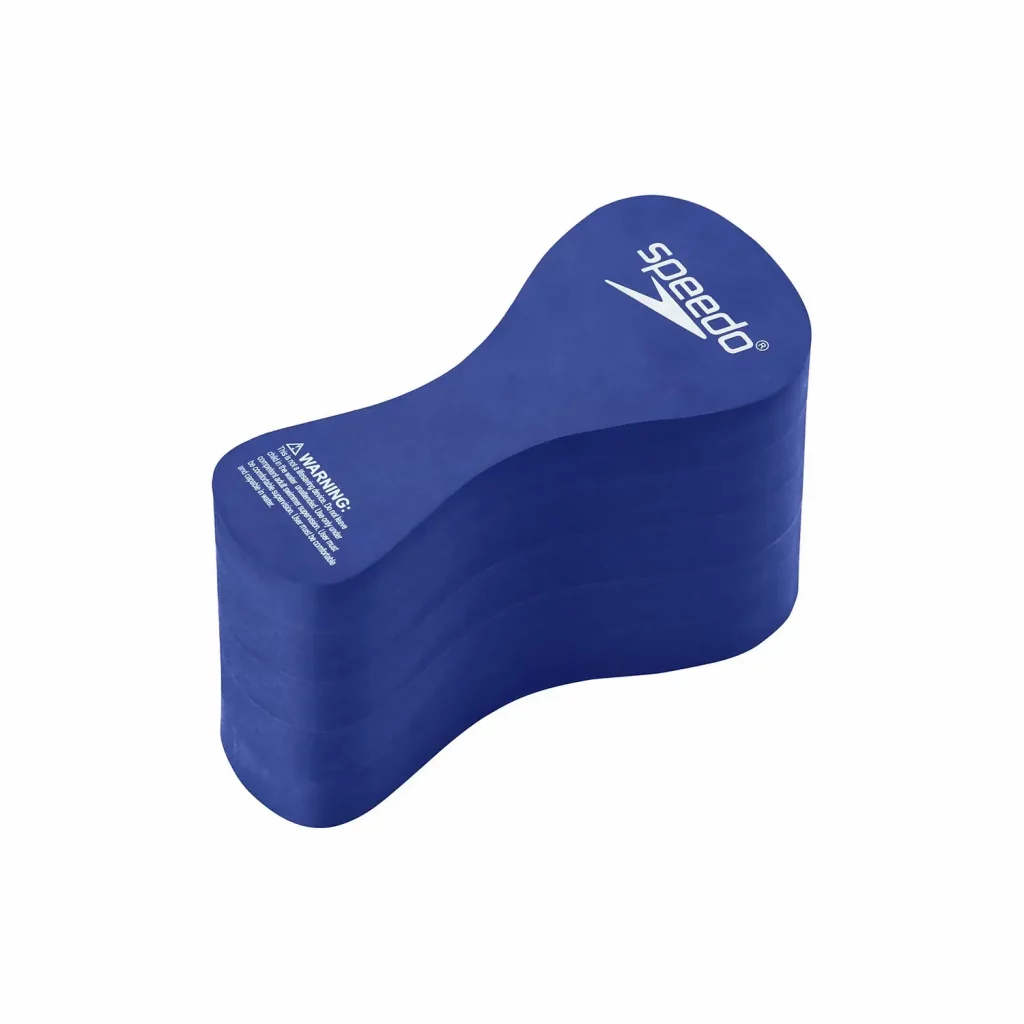
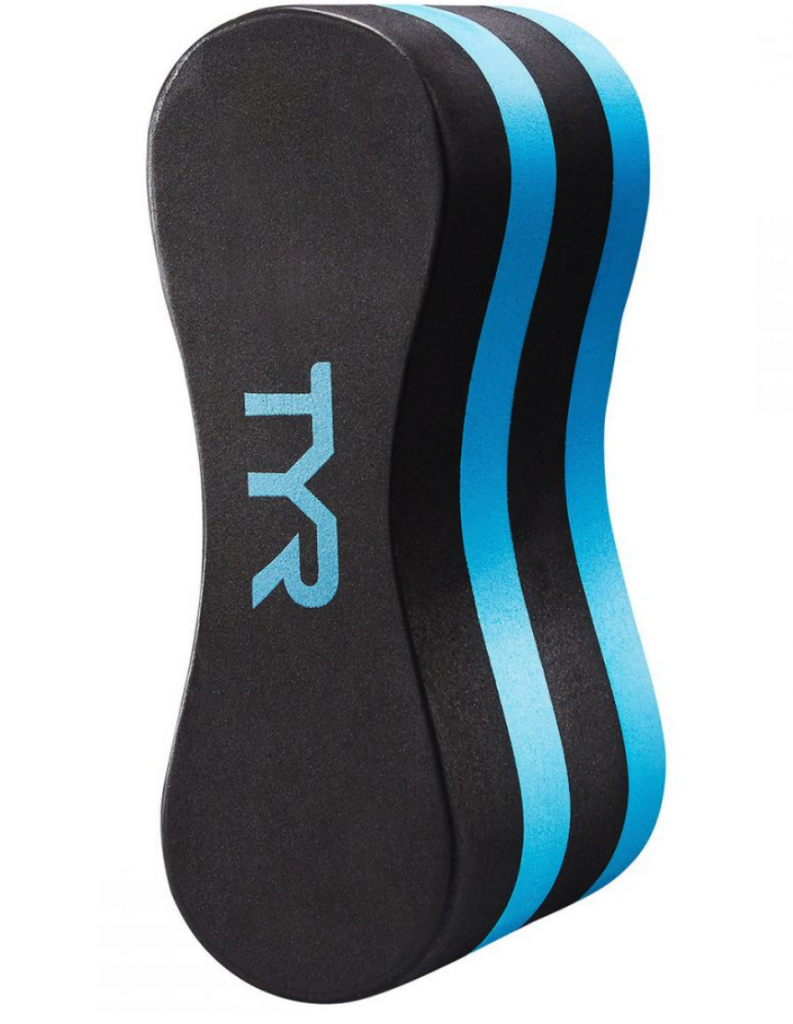
Surprisingly, there are different kinds of Pull Buoys for swimmers. You have the style I posted above with symmetrical sides from A3 Performance. There’s also an uneven style buoy, along with a junior size. See below:
The pros and cons of all these buoy shapes and sizes are really a bit more age dependent. If you look at the buoys in terms of weight, the junior buoy is the lightest, followed by the symmetrical buoy from A3, and then the unbalanced buoy from Speedo.
Heavier buoys create more flotation and change body position more dramatically. That’s why swim training Pull Buoy selection should match both age AND technical maturity.
You’d use the unbalanced buoy from Speedo with the heaviest weight with your highest level of athletes and swimmers. This type of buoy would be best used for your senior swimmers who have been swimming for a while, and are comfortable pulling in all four strokes.
The A3 Performance Symmetrical Style Buoy would be used for 11-12 year olds and some 13-14 swimmers. Pulling puts a good amount of stress on the shoulder joints and for young women, this type of swim training can have an adverse effect on the shoulder joint if done too much.
Here’s something many parents don’t realize: Pull Buoy swimming increases shoulder load because the legs are no longer helping with propulsion. That means the arms absorb more force per stroke.
That’s why it’s really important to make sure you have a coach that’s properly progressing you with pulling, as you age. If you’re looking for a new option for coaching or never even thought about Virtual Coaching, check out our options here. SLAF may be able to help you 🙂
Center of gravity has another impact on pulling between the sexes. Women have a lower center of gravity than men, so a buoy doesn’t balance them out well from top to bottom. You will find men are MUCH faster pulling than women are because of their center of gravity being higher and a buoy sitting right around that fulcrum in their body balance.
So if your daughter feels “slow” swimming with buoy assistance — it’s not a weakness. It’s physics.
No matter your biology though, pulling does have its benefits!
The Junior Size buoys would be used from ages 8-11 years old. With this buoy the lightest, you would use that with your younger swimmers, but not the kiddos that are between 6-7 years old.
I find working on full strokes with the youngest group on your club team is the best bet and leaving most training tools out of the equation for those 6-7 years olds is the best idea. We only ever dabble with fins and a kick board with our 6-7 year olds – unless there’s an anomaly running around.
8-11 Years Old: Junior Pull Buoys
11-14 Years Old: Symmetrical Pull Buoys
14+: Unbalanced Buoys can be introduced!
If you’re wondering when to start swimming with buoy tools — 8 years old is typically the earliest safe introduction, assuming proper stroke mechanics are already in place.
If a swimmer cannot maintain proper body alignment without the buoy — they shouldn’t be using one yet.
Pull Buoys can mask poor kicking habits and core weakness. They are a tool — not a shortcut.
Here’s the deal, if:
Hips sink without the buoy → work on kick.
Shoulders hurt during pull sets → reduce volume.
Technique falls apart → simplify the set.
Tools should BUILD technique — not cover up weaknesses.
Pull Buoy swimming is an excellent strength and technique tool — when introduced at the right time.
Start around age 8. Progress buoy weight as athletes mature. Monitor shoulder health closely.
And remember — tools enhance good technique. They don’t create it.
If you want detailed feedback on your arm mechanics, hand entry, and catch timing while swimming with buoy support, check out our Video Analysis Packages.
Looking for Pull Buoy swim training sets tailored to your exact level and goals? Get Customized Swim Workouts built specifically for YOU!
Coaches — if you want a full system for teaching stroke progressions safely across all ages, explore our Stroke Courses

8 Responses
I as advanced coach am using pool bouts on ages 8 and above we do the Perkins drill with dps push pull with dps breast with dps counts
This reduces their distance per stroke we try for 15-18 per 25 mtrs or 35 or under per 50 or under 70 per 100
Love that!
Thank you very very much
Love the piece!
Thank you so much!!
Great insights! I’ve always been curious about the right time to introduce a pull buoy in my training. The tips you provided on building upper body strength before using it are really helpful. Looking forward to applying these lessons in my next swim!
Thanks for the kind words! You are very welcome!!
Great post! I’ve been wondering about the right time to incorporate a pull buoy into my training. Your tips on building upper body strength and improving technique are super helpful. I’ll definitely give it a try during my next swim session!