What if your Freestyle isn’t slow because you lack strength — but because you’re not actually holding water?
I see this every week. Swimmers work harder, kick more, and pull faster, yet still slip through the water. The missing link is almost always the same: Freestyle Sculling.
Sculling drills teach swimmers how to anchor the water with their hands and forearms instead of simply flailing their arms around.. When Freestyle Sculling is used correctly, it cleans up the catch, improves propulsion, and turns guesswork into control.
Let’s break down how Freestyle Sculling works, why it matters, and the best Freestyle Sculling drills to add to your training — whether you’re a beginner swimmer, a masters athlete, or a coach.

Freestyle Sculling refers to small, controlled hand and forearm movements that create continuous pressure on the water. Instead of pulling straight back, swimmers subtly change the angle of their palms and forearms to maintain propulsion and stability.
Think of your hands like oars steering your body through the water. When the angles are right, the body moves forward smoothly. When they’re wrong, the swimmer slips — no matter how hard they work.
If this concept is new, start with our foundational breakdown: WHAT’S SCULLING IN SWIMMING
For Freestyle swimmers specifically, sculling is one of the fastest ways to develop true feel for the water. It trains a cleaner catch, reduces slipping at the front end of the stroke, and improves efficiency without adding effort.
Most Freestyle problems don’t start at the finish of the stroke. They start before the pull even begins.
When swimmers struggle with Freestyle, it’s often due to a dropped elbow, a flat palm, or an inconsistent catch angle. Others over-pull past the hip, muscle the stroke, or develop asymmetry between their breathing and non-breathing side. These issues are hard to spot at full speed — but sculling exposes them immediately.
Freestyle Sculling drills slow everything down and force swimmers to feel where pressure is actually being created. Instead of guessing, swimmers learn what effective propulsion feels like. That’s why the benefits of sculling swimming go far beyond drills alone: better propulsion, more consistent stroke rhythm, improved shoulder control, and greater efficiency over distance.
There are many types of sculling swimming, but in Freestyle, each variation serves a very specific purpose.
Front-end sculling focuses on the catch. It helps swimmers learn early vertical forearm positioning and teaches them how to apply pressure without dropping the elbow. Mid-stroke sculling emphasizes continuous propulsion through the power phase of the pull, while back or hip-level sculling improves awareness of the finish and helps swimmers maintain momentum through the finish.
Each variation targets a different weakness, but all of them reinforce one key idea: propulsion comes from pressure, not speed.

Video Library: FR Drill: Torpedo Scull
This is one of the most challenging — and revealing — Freestyle Sculling drills.
Swimmers start on their back with their arms overhead in an 11-and-1 position and their legs pointed toward the opposite wall. The hands push the water and scull backward, extending and bending the elbows rhythmically. All forward motion comes from the arms, which means body line and hand speed matter immediately.
This drill works because it eliminates cheating. There’s no kick to rely on and no momentum to hide behind. Weak hand pressure shows up fast.
Coach cue: Quick hands, smooth pressure, no splashing.

Video: FR Drill: Bucket Scull
The Bucket Scull is one of the best entry-level sculling drills for Freestyle swimmers.
Swimmers start on their back with their knees tucked just under the surface, as if sitting in an imaginary bucket. From there, they scull side to side while moving head-first down the pool.
Because the body position is compact and slow, swimmers can focus entirely on palm angle and pressure. This drill builds awareness quickly and is ideal for Freestyle Sculling drills for beginners or younger swimmers.
Coach cue: Press the water — don’t slap it.
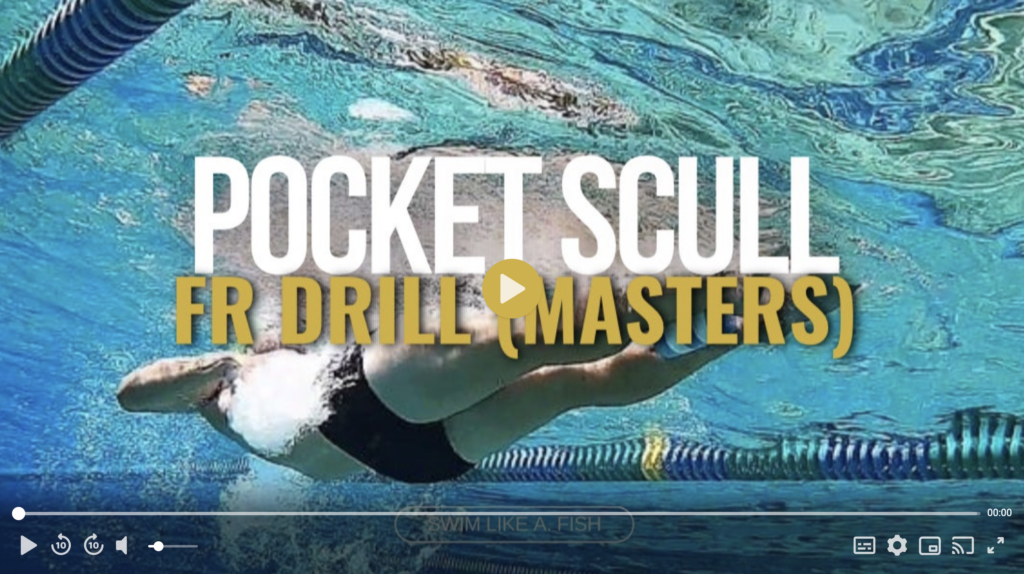
The Pocket Scull bridges sculling directly into the Freestyle pull pattern.
Performed on the back with a pull buoy between the ankles, swimmers scull forward with their hands positioned near the hips, moving feet-first down the pool. This angle helps swimmers feel forward momentum while reinforcing pressure through the finish of the stroke.
For masters swimmers and triathletes, this drill is especially valuable because it improves efficiency without stressing the shoulders.
Coach cue: Pressure back — not down.
Sculling only works if it carries over to swimming. That’s why isolated Freestyle Sculling Drills should always be paired with movements that reconnect hand pressure to the actual Freestyle Stroke.
Along with the Torpedo, Bucket, and Pocket Sculls above, this short YouTube session adds two drills that bridge sculling into full-stroke Freestyle:
In this video, we use the People Paddle Scull and the Hesitation Drill to reinforce what proper pressure feels like once the arms start moving faster.
This drill exaggerates the surface area of the hands, making it immediately obvious whether the swimmer is holding water or slipping through it. It pairs perfectly with Bucket and Torpedo Sculls because it reinforces the same concept — pressure against the palm and forearm — but with slightly more movement and rhythm.
Swimmers who rely on arm speed instead of pressure will feel this breakdown right away.
The Hesitation Drill slows the Freestyle Stroke at the front end, forcing the swimmer to set the catch before applying power. This is where many Freestyle swimmers rush, drop the elbow, or lose pressure.
Used after sculling drills, hesitation work helps swimmers transfer water feel into a controlled, effective Freestyle Pull.
Freestyle Sculling should follow a progression, not be sprinkled randomly into practice. The goal is to move from isolated feel → connected pressure → full stroke.
Here’s a simple, effective pre-set that includes all of the drills covered in this article:
Rest as needed to maintain quality. This is not about speed — it’s about awareness.
If swimmers don’t feel a difference when they return to full stroke, that’s valuable feedback. It tells you exactly where connection is being lost.
The biggest mistake swimmers make with sculling is rushing it. Others rely on kicking to create speed or let the elbows collapse. Treating sculling as nothing more than warm-up filler defeats its purpose.
Sculling drills are teaching tools. When done with focus, they reveal exactly how well a swimmer is controlling the water.
Sculling drills don’t make swimmers fast by themselves.
They make swimmers honest.
When pressure disappears, sculling exposes it. When the catch improves, Freestyle speed follows — without extra effort.
If you want expert eyes on your catch and pull mechanics, start with SWIM VIDEO ANALYSIS PACKAGES. You’ll get personalized feedback that shows exactly where you’re losing pressure — and how to fix it.
For swimmers ready to rebuild their Freestyle step by step, HOW TO SWIM A FASTER FREESTYLE IN 90 DAYS walks you through proven drills, progressions, and video breakdowns designed to create a stronger, more efficient stroke.
For coaches who want to teach Freestyle with more clarity and confidence, FUNDAMENTALS OF FREESTYLE FOR COACHES breaks down the stroke from the catch forward — so your swimmers stop guessing and start holding water.
Your Freestyle doesn’t need more effort.
It needs a better connection.
Start sculling.
About the Author
Abbie Fish is the founder and head coach of Swim Like A Fish, a global education platform for swimmers and swim coaches. She is known for her TECHNIQUE-FIRST coaching approach—helping athletes move better, hold more water, and swim faster without unnecessary strain. Abbie works with swimmers of all levels, from beginners to elite competitors, and teaches coaches how to break down complex skills into clear, repeatable systems that actually transfer to performance.