
How Rules Shape Speed, Technique, and Disqualifications
What if I told you that most Freestyle disqualifications are not rule problems — they’re technique problems?
USA Swimming Freestyle rules don’t exist to slow swimmers down.
They exist to define efficient movement, protect fair racing, and expose technical weaknesses under pressure.
And here’s the truth coaches see every season:
The best Freestyle technique in the world is built to survive the rules.
Let’s walk through the Freestyle USA Swimming rules, the most common swimming DQ rules, and how elite swimmers turn those rules into speed — from the start, to the turn, to the finish.
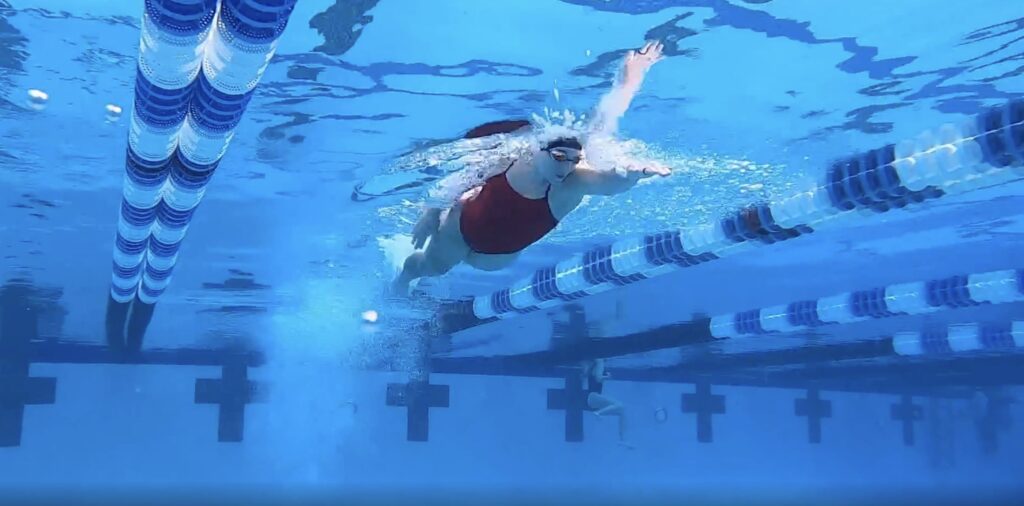
Many swimmers treat rules as something to memorize the night before a meet.
Elite swimmers treat rules as technical boundaries.
That difference matters.
When technique is sloppy, rules show up as:
• Disqualifications
• Lost momentum
• Panic turns
• Inefficient breakouts
When technique is sound, the rules disappear — and speed shows up.
Let’s start with the non-negotiables for Freestyle events under USA Swimming rules.
The official language comes from the USA Swimming 2025 Rulebook:
Freestyle is exactly what the name implies: swimmers may use any stroke they choose and may switch strokes at any time.
In theory, a swimmer could race using Butterfly, Backstroke, or something unconventional.
In reality, nearly all competitive swimmers choose the Front Crawl.
Why?
Because the Front Crawl:
• Produces the highest sustainable speed
• Allows continuous propulsion
• Fits Freestyle swimming rules most efficiently
But freedom doesn’t mean chaos.
Even when swimming Front Crawl, USA Swimming rules require that:
• Some part of the body must touch the wall at the completion of every length and at the finish
• Some part of the swimmer must break the surface continuously throughout the race
• Underwater distance is limited after the start and each turn
This is where many USA Swimming disqualification rules appear — not because swimmers don’t know the rules, but because technique breaks down under speed and fatigue.
One of the most misunderstood Freestyle rules in swimming is the underwater limit.
After the start and after every turn:
• Swimmers may be fully submerged
• But only up to 15 meters (16.4 yards)
• By that point, the head must break the surface
Underwater is fast.
Surface swimming creates drag.
So swimmers naturally want to stay underwater longer.
Elite swimmers don’t push this limit blindly.
They time the breakout perfectly.
Video: Freestyle Breakout (Pro)
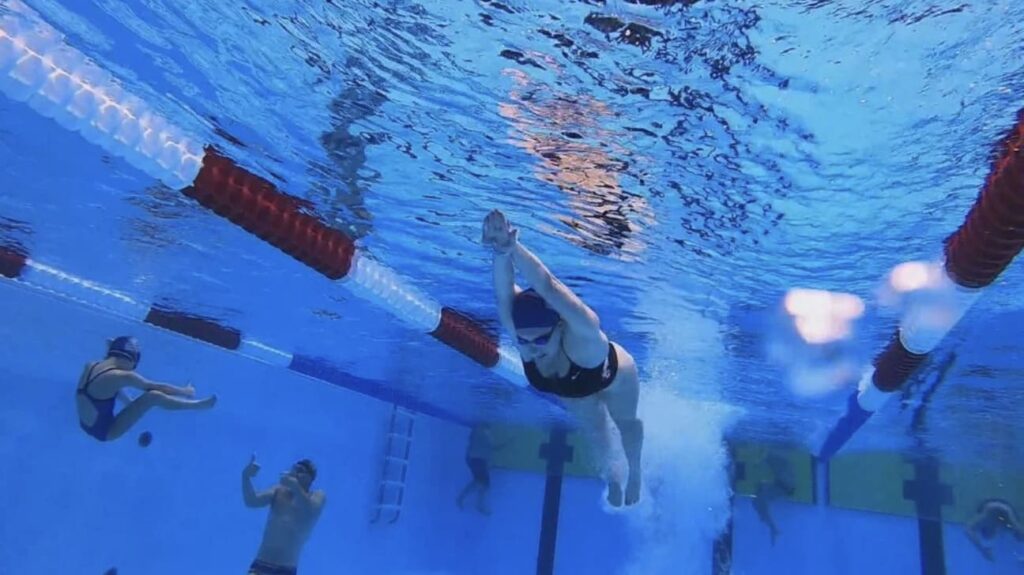
In this underwater example, notice how the swimmer:
• Transitions smoothly from Dolphin Kick to Freestyle Kick
• Maintains a long, tight bodyline
• Uses momentum — not force — to reach the surface
The moment a swimmer breaks the surface, speed starts leaking.
That’s why body position at breakout matters more than power.
False starts are simple — and unforgiving.
Understanding the start sequence matters more than most swimmers realize:
• Long whistle — swimmers step up onto the block
• “Take your mark” — swimmers assume their set position
• The signal (beep) — this is when you GO
Most false starts don’t happen before the whistle.
They happen after “take your mark” and before the signal — when swimmers flinch, anticipate, or lose control trying to guess the start.
If a swimmer initiates movement before the starting signal, they may be disqualified under false start rules in swimming. In USA Swimming, the call must be observed by officials, with optional confirmation through automatic equipment.
At the competitive level, false starts are rarely caused by impatience.
They are almost always caused by loss of control on the block.
Speed off the start only matters if the swimmer:
• Remains still until the signal
• Maintains balance in the set position
• Enters the water in a clean bodyline
This video highlights one of the most common technical errors at the start:
not lifting the back leg high enough.
When the back leg stays low:
• The body launches up instead of out
• Swimmers enter the water flat instead of at an angle
• Overall explosiveness is reduced
Cleaning up back-leg mechanics improves stillness before the signal, sharpens reaction timing, and allows for a legal, controlled takeoff. False starts are prevented by starting from a stronger, more stable position — not by trying to “wait longer” on the block.
Let’s connect rules directly to movement.
Staying Underwater Too Long
Rule issue: Violates the 15-meter limit
Technique fix: Breakout timing and underwater discipline
Missed Wall Touch
Rule issue: No contact at the turn or finish
Technique fix: Spatial awareness and controlled approach
False Start
Rule issue: Movement before the signal
Technique fix: Start discipline and reaction control
Sloppy Finish
Rule issue: Failure to complete the distance legally
Technique fix: Stroke finish mechanics
Every DQ is feedback.
The rule simply exposes the flaw.
Many programs teach rules separately from technique.
Elite programs don’t.
They teach:
• Why the rule exists
• What efficient movement looks like inside the rule
• How fatigue affects legality
That’s the real pipeline:
Rule → Awareness → Movement → Speed
Some swimmers believe rules restrict expression.
Reality?
Rules reward efficiency.
The fastest Freestyle swimmers in the world don’t fight the rules —
they optimize inside them.
That’s why elite Freestyle looks:
• Clean
• Simple
• Repeatable
Not flashy.
Not forced.
Just fast.
Freestyle rules aren’t obstacles.
They’re guardrails for great technique.
If a swimmer keeps getting disqualified:
It’s not bad luck.
It’s a technical signal.
Fix the movement — and the rules stop being a problem.
Swimming fast only matters if it’s LEGAL — and repeatable under pressure.
If you want expert eyes on your Freestyle starts, turns, breakouts, and finishes:
SWIM VIDEO ANALYSIS PACKAGES
For Coaches:
If you want a clear system for teaching legal, efficient Freestyle from the ground up:
FUNDAMENTALS OF FREESTYLE FOR COACHES
For Swimmers:
If you’re ready to clean up your technique and race Freestyle faster — without risking DQs:
HOW TO SWIM A FASTER FREESTYLE IN 90 DAYS
Control first.
Speed second.